
PDF · 5 pages
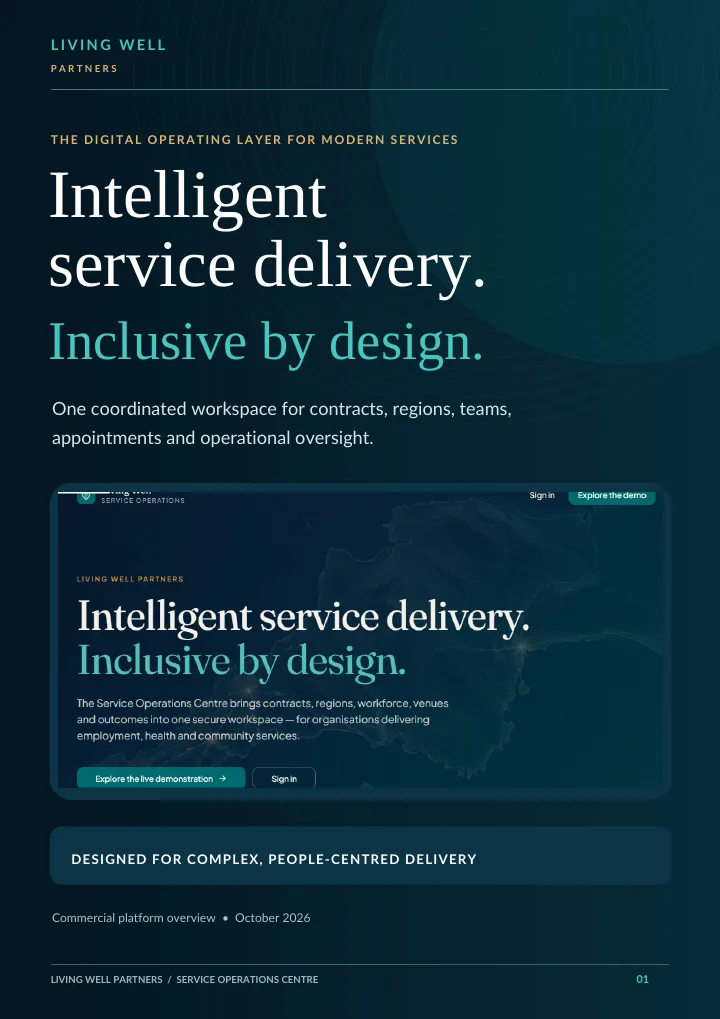
Service Operations Centre — Service Brochure
Our five-page service brochure: how the Service Operations Centre brings contracts, regional teams, workforce availability, appointments, venues and operational oversight into one workspace.
Responsible innovation / Lean service delivery
Living Well Partners helps businesses and organisations explore how service delivery can be redesigned to use resources more intelligently. By combining lean systems thinking, inclusive digital options and more efficient operational planning, we identify opportunities to reduce unnecessary journeys, duplication and resource use — while protecting accessibility and service quality.
Where we focus
Many organisations focus on equipment, buildings and energy suppliers when considering emissions. Service delivery can be another area worth examining: how teams travel, where appointments are held, how referrals move between services and whether existing digital infrastructure could be reused. We help organisations explore these design choices, understand the trade-offs and prioritise practical changes.
Identify existing platforms, tools, approved resources, service processes and premises that can be reused or adapted instead of duplicated.
Explore locality-based appointment clustering, practical journey planning, venue coordination and reduced repeat trips.
Combine in-person, remote and hybrid options based on service needs, accessibility, safeguards and participant choice.
Examine referral processes, hand-offs, waiting times, administrative duplication and avoidable resource use.
Establish a baseline, model alternative scenarios and track relevant activity using consistent methods and UK conversion factors.
How it works
Step 1
Discover
Understand current activity and constraints.
Step 2
Map
Identify resource use, journeys, venues and duplication.
Step 3
Model
Compare feasible delivery scenarios.
Step 4
Implement
Agree a phased redesign, technology or operational support.
Step 5
Evaluate
Review service quality, accessibility, cost and emissions activity.
Services and implementation scope are agreed for each organisation; the illustration is not a guaranteed emissions reduction programme.
Free tool
Use our free Service Carbon Impact Calculator to compare current and proposed annual service-delivery activity. Explore how changed journeys, staff arrangements and energy use may affect indicative emissions. You can print your results or export scenario data. No account required.
What the calculator shows
All figures are indicative. The calculator is not a complete corporate footprint or a compliant Carbon Reduction Plan, and runs entirely in your browser.
Where our Service Operations Centre can help
Our Service Operations Centre brings contracts, regional teams, workforce availability, appointments, venues, referrals and operational oversight into one workspace. Where suitable, this can help organisations explore less fragmented delivery and more efficient scheduling. The platform is available for demonstrations and early commercial partnership discussions; capabilities, configuration and assurance are agreed before operational deployment.
Downloads
PDF · 5 pages
Our five-page service brochure: how the Service Operations Centre brings contracts, regional teams, workforce availability, appointments, venues and operational oversight into one workspace.
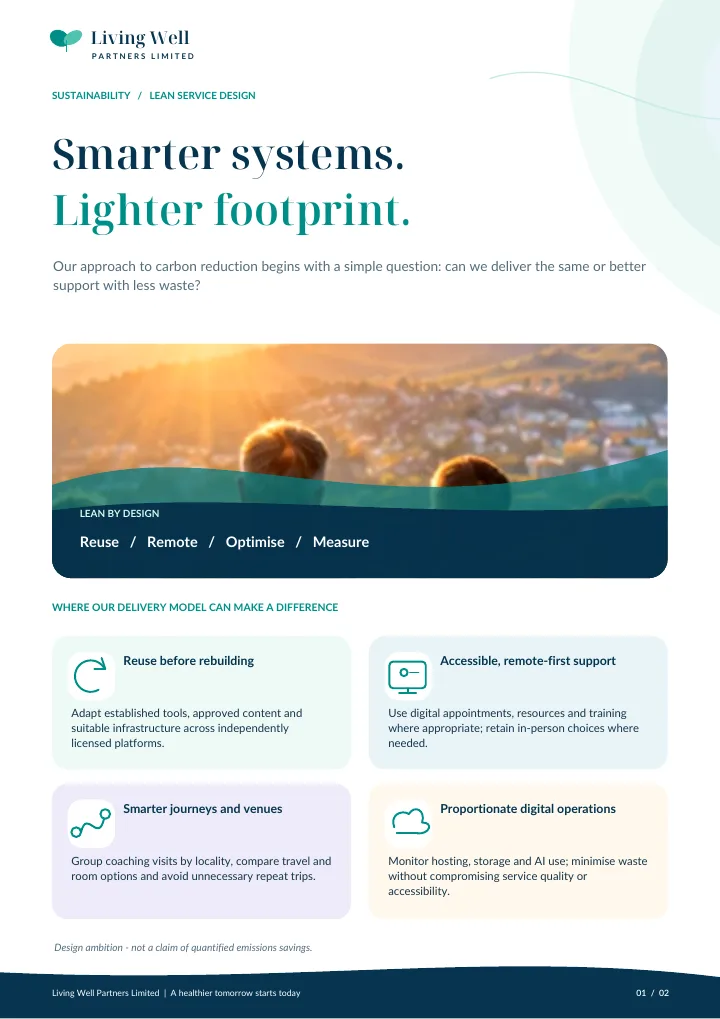
PDF · 2 pages
Our two-page leaflet on lean service design: reuse before rebuilding, smarter journeys and venues, proportionate digital operations, and how we measure and improve.
Policy context
Environmental reporting and carbon reduction are increasingly relevant to procurement. The UK Government’s PPN 006 applies to specified major central-government procurements, generally those above £5 million per year including VAT where relevant and proportionate. NHS England has published updated supplier carbon reporting and Carbon Reduction Plan requirements for applicable procurements from 1 April 2027. Requirements vary by buyer, threshold and contract; organisations should check their own obligations.
Our own commitments
Who can benefit?
Tell us how your services currently operate and what you hope to improve. We can discuss a proportionate discovery, redesign or implementation partnership based on your needs.
Living Well Partners provides service design, operational improvement and digital implementation support. We do not claim to be an accredited carbon auditor or to certify statutory or procurement-compliant Carbon Reduction Plans. Estimated carbon changes depend on the assumptions, reporting boundaries, actual implementation and measured activity. Consider the additional digital, home-working and provider emissions of changed delivery models.